

Description
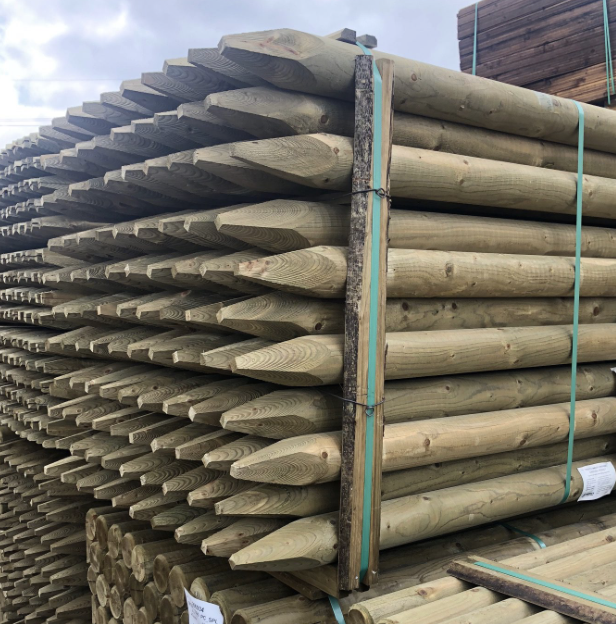
Machine Round Posts UC4 1.8m.
Made using high quality softwood and pressure treated, these UC4 machine round pointed posts are designed to last for up to 15 years in all weathers thanks to its UC4 treatment.
Available in 75mm and 100mm diameter. Spiked bottoms.
Complementing 38mm x 50mm Rails, available in 4.8m and 3.6m lengths.
Don’t Be Duped by Pressure-Treated Timber – Make Sure Yours Is Treated for the Right Use!
Not all pressure-treated timber provides the same level of protection. Timber treatment is divided into Use Classes according to the environment in which the wood will be installed and its expected exposure to moisture. Selecting the correct Use Class helps protect timber against fungal decay and insect attack while improving its service life.
Use Class 1 – Internal and Dry
UC1 timber is intended for internal, permanently dry locations with no risk of wetting. Typical applications include internal joinery and other timber kept within a protected environment.
Use Class 2 – Internal with Occasional Moisture
UC2 timber is used above ground and under cover but may occasionally be exposed to moisture. Common examples include roofing battens, roof timbers and timber used within external wall construction.
Use Class 3 – External and Above Ground
UC3 timber is suitable for outdoor applicationspositioned above ground. It may be regularly exposed to rain but should not remain in permanent contact with soil or fresh water. Typical applications include fence rails, cladding, decking boards and above-ground garden structures. UC3 may be specified for coatedor uncoated timber, depending on the application.
Use Class 4 – Ground or Fresh-Water Contact
UC4 provides the level of protection required for timber that will be in direct contact with the ground, below the damp-proof course or permanently exposed to fresh water. This includes fence posts, gate posts, deck-support posts and landscaping timbers. Exterior structural supports exposed to these conditions should be treated to Use Class 4.
Always check the Use Class shown within the individual product description before ordering. Timber should be correctly installed and maintained, while any cuts, notches or drilled areas should be protected using a suitable end-grain preservative.
Explore our treated timber products or read the Wood Protection Association’s guidance on preservative treatments for further information.
Why Are My Machine Round Posts UC4 1.8m Not Incised?
Specifying, buying and installing pressure treated timber.
You may notice small, regular marks across the surface of some of our Use Class 4 timber. These marks are known as incisions, and they are deliberately made before the timber is pressure-treated. They are not damage, manufacturing faults or signs of poor-quality timber.
Incising creates small channels in the timber, helping the preservative penetrate more deeply and evenly. This is particularly important for UC4 products such as fence posts, gate posts, deck-support timbers and landscaping materials, which are installed in or near the ground or used as exterior structural supports. These demanding conditions require a greater level of protection against moisture and fungal decay.
Why Isn’t All UC4 Timber Incised?
Different timber species absorb preservatives at different rates. Spruce and other less permeable timbers can be more difficult to treat effectively and may therefore require incising, specialist preparation or an extended pressure-treatment cycle. In contrast, pine and redwood are generally more receptive to preservative treatment and may achieve the required UC4 specification without visible incisions making it perfect for our garden buildings.
Consequently, the absence of incision marks does not automatically mean that timber has been inadequately treated. Equally, incisions alone do not prove that timber meets UC4 requirements. The timber species, moisture content, preparation, preservative penetration and treatment process must all work together to achieve the required specification.
The incisions may become slightly more visible as the timber dries and weathers. However, this is normal and does not reduce its structural performance. When installing treated timber, avoid unnecessary cutting after treatment. Any unavoidable cuts, notches or drilled areas should be protected using a suitable end-grain preservative in accordance with the manufacturer’s instructions.
For further technical information, visit the Wood Protection Association’s guidance on timber-treatment and incising technologies.


